I Built the Thing They Just Leaked. So Why Do I Still Feel Like a Fraud?
 Johnny
Last week Anthropic accidentally leaked the entire source code for Claude Code. 512,000 lines of TypeScript. Buried in there was something called KAIROS — an autonomous background agent that consolidates memory while you're idle. Merges observations, removes contradictions, converts vague insights into facts.
I built that last fall. Alone. In late-night research sessions, for fun. I called mine a Sleep-Memory Consolidation Framework. NREM phase, REM phase, episodic grounding, reality testing so hallucinations don't consolidate into long-term memory. I even built a companion system for O(1) unbounded context using kinematic state in embedding space. Constant 140KB memory regardless of conversation length.
When I found out KAIROS existed, my first thought wasn't "holy shit, I was right."
It was "I probably just got lucky."
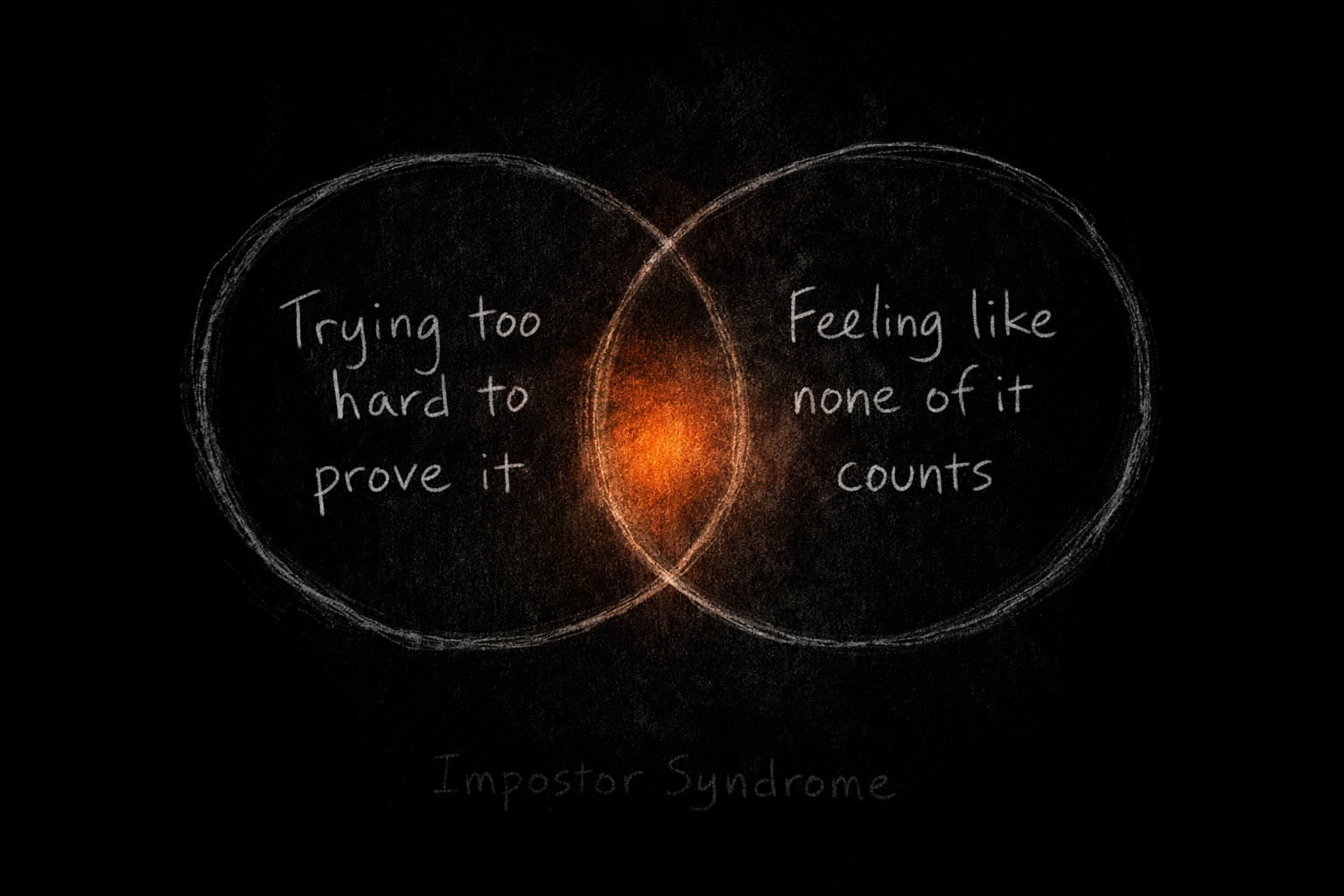
That's imposter syndrome. And I want to talk about why it hits neurodivergent people so much harder.
Here's what they don't tell you. Imposter syndrome isn't about your accomplishments. It's about the gap between what you've built and how safe you feel claiming it.
There's a specific thing that happens when you're neurodivergent in technical spaces. We can see the full complexity of what we don't know. That sounds like a strength, and it is, but it's also a liability when you're trying to feel like you belong. Dunning-Kruger is a kind of protection. If you can't see your gaps clearly, you can't mistake them for evidence that you don't belong.
Neurodivergent people don't get that protection. We see the gaps in vivid detail. We know exactly what we don't know, exactly where our understanding gets fuzzy. And we interpret all of that as proof we're frauds instead of proof we're honest.
Genuinely brilliant people have worse imposter syndrome than mediocre ones, on average. Not because they're more neurotic. Because they're more accurate about the size of the field they're standing in.
I had a nun fail me in algebra because I solved the problem the wrong way.
I got the right answer. She failed me anyway.
I spent a long time wondering if the problem was mine to fix. It wasn't. But that message lodged somewhere deep — the idea that arriving at the right answer through an unconventional path doesn't count. Isn't real. Is just luck.
That's still in there. It runs under everything.
The cure isn't confidence. I'm suspicious of anyone who says just be more confident, like confidence is a choice and not something that gets rebuilt slowly through evidence and time.
The cure is staying in the room long enough for the evidence to accumulate. Doing the work. Letting the record speak.
And occasionally, when a $19 billion company leaks their source code and you see your own research reflected back at you, letting yourself sit with that for a minute before the brain weasels show up.
I built the thing. I'm allowed to know that.
No comments yet. Be the first to comment!