This Too Shall Pass: The Neurodivergent Guide to Surviving the Moment That Feels Like Forever
 Johnny
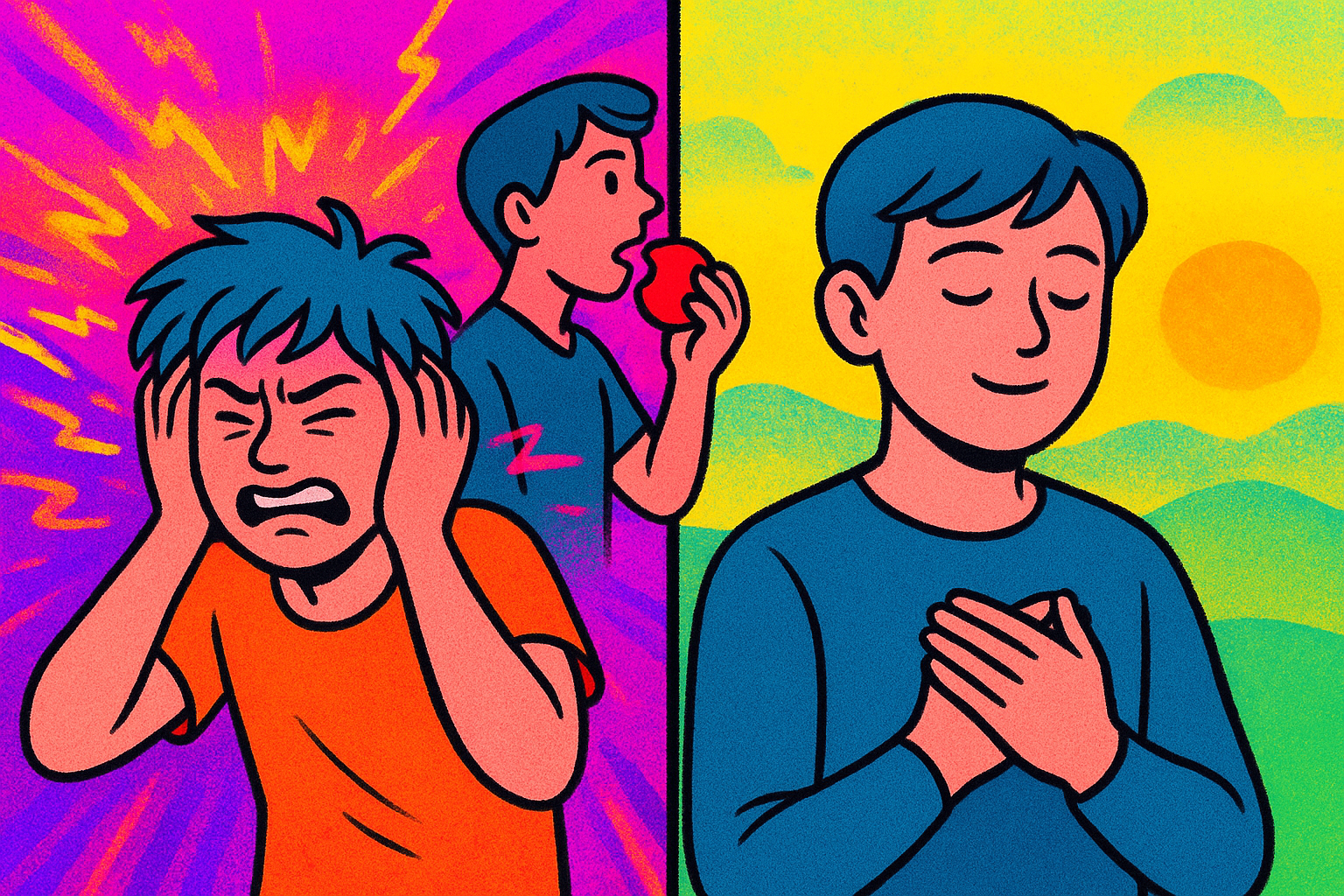
You know that moment when you're in the middle of a sensory overload episode and your brain is screaming "THIS IS IT. THIS IS HOW I LIVE NOW. FOREVER. IN THIS FLUORESCENT HELL WITH SOMEONE EATING AN APPLE TOO LOUDLY."
Plot twist: It's not.
The Big Secret Nobody Told Us
Here's something that took me an embarrassingly long time to learn—probably because my autistic brain was too busy cataloging every terrible sensation to notice: Nothing is permanent. Not the good stuff (unfortunately), but more importantly, not the bad stuff either.
That meltdown you're having? Temporary.
The sensory overload that makes you want to yeet yourself into the sun? Temporary.
The executive dysfunction that has you staring at your phone for 45 minutes instead of doing the One Simple Task? Also temporary (and honestly, relatable content).
The overwhelming anxiety that feels like it's literally rewiring your nervous system? You guessed it—temporary.
"But John, It Doesn't FEEL Temporary"
I hear you. When you're in the thick of it—when the lights are too bright, the sounds are too loud, and your nervous system has decided that existing is a full-contact sport—the word "temporary" feels like a cruel joke.
It's like telling someone whose house is on fire, "Don't worry, fires eventually go out!" Thanks, that's super helpful while I'm on fire.
But here's the thing about living with autism and/or ADHD together in daily life: we tend to experience emotions and sensations at approximately 4,000% intensity. That's not a bug, it's a feature. An annoying, exhausting feature that nobody asked for, but a feature nonetheless.
And because we feel everything so intensely, our brains convince us that the current state is The Permanent State. It's not.
The Science of "This Too Shall Pass" (But Make It Neurodivergent)
Your nervous system is not a light switch. It's more like a really dramatic dimmer that someone spilled coffee on. It takes time to regulate.
When you're in sensory overload or experiencing an autism meltdown, your body is flooded with stress hormones. Those hormones don't just poof disappear the moment the offending stimulus stops. They have to metabolize. They have to work through your system like that one coworker who takes forever to leave after a meeting.
This is why autism meltdown recovery takes time. This is why you feel wiped out after a shutdown. Your body literally ran a marathon while you were standing still in Target trying to handle the combination of fluorescent lights, screaming children, and someone's very aggressive perfume choices.
But—and this is crucial—those hormones DO clear. The nervous system DOES regulate. The storm DOES pass.
Every. Single. Time.
A Brief History of Things That Felt Permanent But Weren't
Let me take you on a tour of moments that my brain was CONVINCED were forever:
The Great Grocery Store Incident of 2019: Full shutdown in aisle 7. Convinced I would never be able to leave that store. Reader, I left that store.
The Zoom Meeting Meltdown: Sensory overload from 47 people unmuting at once. Thought I'd never recover. Recovered by dinner (okay, by the next day, but still).
The 3 AM Anxiety Spiral: The one where I was certain that every mistake I'd ever made was about to converge into one massive life-ruining event. Fell asleep at 4 AM. Woke up and literally forgot what I was worried about.
The Hyperfocus Hangover: After 12 hours of coding without eating. Felt like my brain was permanently broken. It was not. Just needed some food.
The ADHD Plot Twist
Here's where it gets interesting for my fellow AuDHD folks: our ADHD brains have absolutely no sense of time. None. Zero. Time is a flat circle and also a lie.
This means that when something bad is happening, our time-blind brains go "Ah yes, this has been happening forever and will continue forever." Meanwhile, it's been 7 minutes.
But we can use this chaos gremlin energy for GOOD. Because just like our brains can't accurately assess how long bad things last, they're also delightfully distractable. That hyperfocus that makes us forget to eat? It can also make us forget we were in crisis mode 20 minutes ago because ooh, is that a new video essay about a topic I've never thought about before?
Practical Strategies for Riding the Wave
Okay, enough philosophy. Let's get tactical:
1. The "This Has a Timestamp" Technique
When you're overwhelmed, literally look at the time. Make a mental note. Then later (when you've regulated), look at the time again. Your brain needs EVIDENCE that things end. Build that evidence folder.
2. Create a "Proof of Survival" List
Write down every meltdown, shutdown, sensory overload episode, and anxiety spiral you've survived. All of them. Look at that list when you're struggling. You have a 100% survival rate so far. Those are excellent odds.
3. The 90-Second Rule
Neurologically, the chemical process of an emotion only lasts about 90 seconds. Everything after that is your brain re-triggering the response. This isn't about suppressing emotions—it's about knowing that waves have peaks, and peaks don't last.
4. Build Your Regulation Toolkit
Weighted blankets, noise-canceling headphones, stim toys, dark rooms, cold water on wrists—whatever helps you come down faster. Not to STOP the experience, but to support yourself THROUGH it.
5. Post-Crisis Compassion
After a meltdown or shutdown, you're going to feel like garbage. That's normal. That's the hormone hangover. It's also—say it with me—temporary. Rest. Recover. Don't judge yourself for needing time.
The Hope Part (Because I Promised)
Listen. Living with autism and ADHD is not easy. Nobody is pretending it is. Sensory overload is genuinely overwhelming. Meltdowns are exhausting. Executive dysfunction is frustrating. The daily management of a neurodivergent brain in a neurotypical world is a full-time job that we don't get paid for.
But there's profound hope in impermanence.
Every bad moment you've ever had has ended. Every single one. Not because you're special (I mean, you ARE, but that's not why), but because that's how moments work. They end. They give way to the next moment. And the next. And the next.
The sensory nightmare of today is not your forever. The meltdown that's consuming you right now is a wave, and waves—by definition—recede. The anxiety that's telling you everything is terrible forever is lying to you, because anxiety is a drama queen with no concept of reality.
You're not stuck. You're in motion. Always.
The Bottom Line
Neurodivergent brains are intense. They feel everything at maximum volume, which means the hard stuff hits HARD. But it also means the good stuff—when it comes, and it will come—hits just as intensely.
So the next time you're in the middle of it—the sensory chaos, the emotional overwhelm, the "why is existing so LOUD" of it all—try to remember: this is a moment, not a life sentence.
You've survived every single "unbearable" moment so far. That's not a coincidence. That's a pattern. And patterns are basically the autistic brain's love language.
This too shall pass. It always does.
And then there will be a new moment. Hopefully one with better lighting and fewer people eating apples.
Written by someone who has convinced themselves approximately 847 times that a current feeling was permanent. It never was. It never is.
No comments yet. Be the first to comment!